
Two studies benchmarking four language models on a partially migratory elk herd with a published analysis of its decline in migration. Study 1 hands the models 234 elk-years of GPS telemetry under three framings — no context, the real system named, and a false species label — and scores how much structure they recover. Study 2 removes the data entirely and supplies an inventory of datasets diluted with plausible decoys, asking each model to design a study around them. Dataset selection is near-ceiling and undisturbed by dilution; structure recovery is shallow. The models most careful with the numbers were the least willing to question a false premise handed to them.
An assessment of the RK4 method's performance in modelling the chaotic dynamics of a simulated damped driven pendulum, successfully capturing topological features including braiding and unstable periodic orbits.
Reviewing the current and future potential of quantum mechanical applications to technology, with a particular interest in its contributions to the United Nations' Sustainable Development Goals.
An analysis of methanol diffusion in the TIP3P model of water...

I am an undergraduate studying an MPhys in Theoretical Physics at the University of Sheffield.
Most of my work is computational; building pipelines for simulations of particle and plasma physics from source — particle-in-cell plasma runs, parton showering, detector-level signatures — and written projects on the numerical integration of chaotic systems and the molecular dynamics of methanol in water. I have also spent a summer researching movement ecology and AI under the supervision of Prof. Potts and Prof. Xing, using GPS telemetry data from the Ya Ha Tinda elk herd to write a comparative report on the responses of many language models.
This site holds a record of that work: papers, coursework, self-led projects, and the reading enabling them.
Work begun outside of coursework and carried out independently: theory written up for its own sake, and simulation pipelines built from source to learn the tooling used in plasma and particle physics.
A Nod to the Geometry of Holes
A geometric theory of cavities built on a single invariant - aperture cardinality - developed first into a trichotomy of sealed voids, pockets, and through-holes, then argued to be a coarsening of the true structure. A unification theorem shows that every pocket arises as the Hausdorff limit of through-holes via aperture-merge deformations, collapsing the trichotomy into a natural dichotomy: voids and holes, with pockets occupying the lowest stratum of a filtration of hole-space.
This paper was written with substantial AI assistance, as disclosed in its acknowledgements. It is unrefereed exploratory work, and several of the proofs are currently being reworked. It is listed here for the record rather than as a finished result.
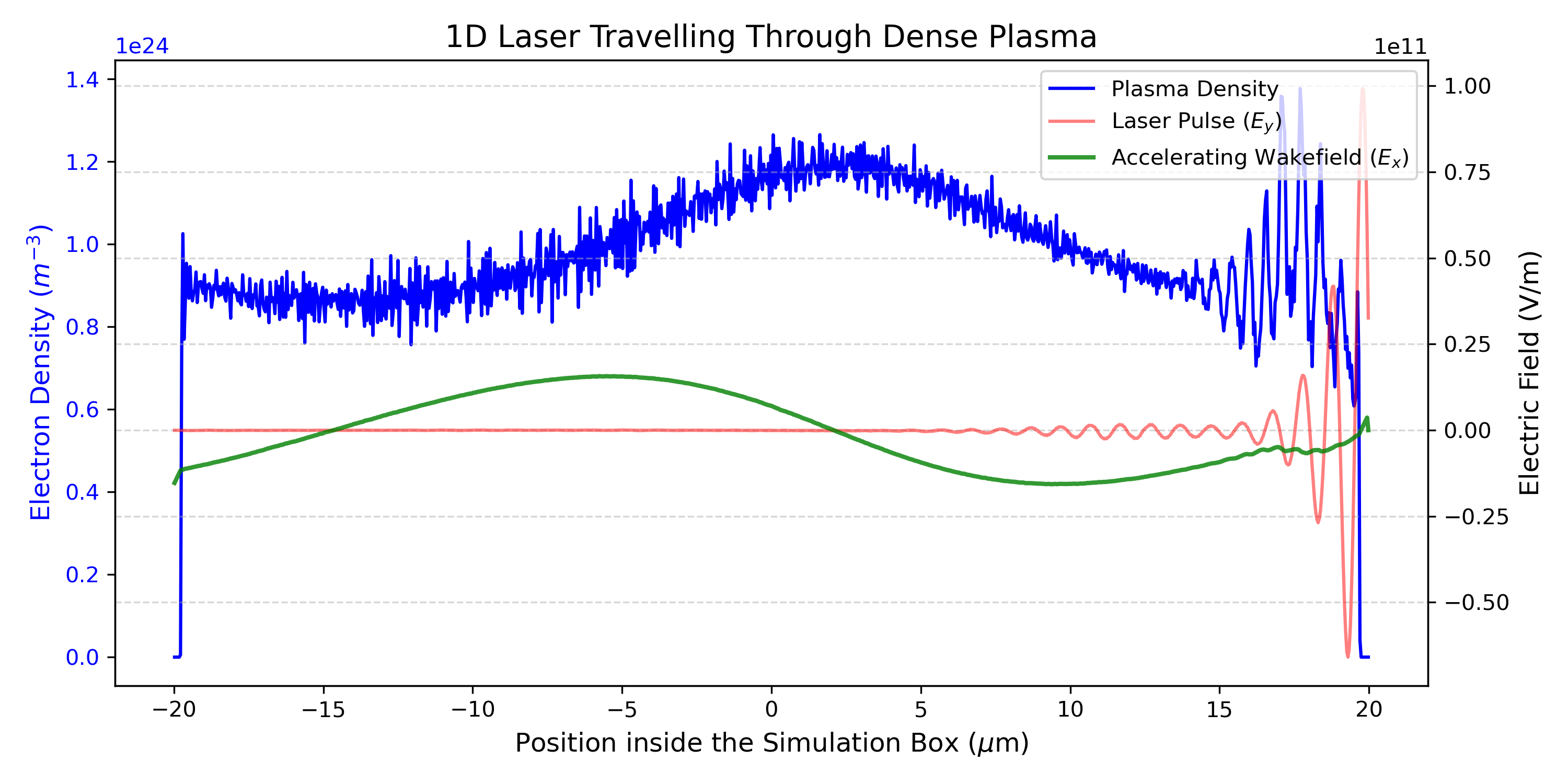
Particle-in-Cell Simulation of Laser-Driven Wakefields in Dense Plasma
A Particle-in-Cell (PIC) simulation built from source, demonstrating a high-intensity laser pulse travelling through a dense plasma medium and successfully extracting and plotting the longitudinal accelerating wakefield it generates. The repository contains the input deck, build configuration, and post-processing scripts used to reconstruct the field structure.
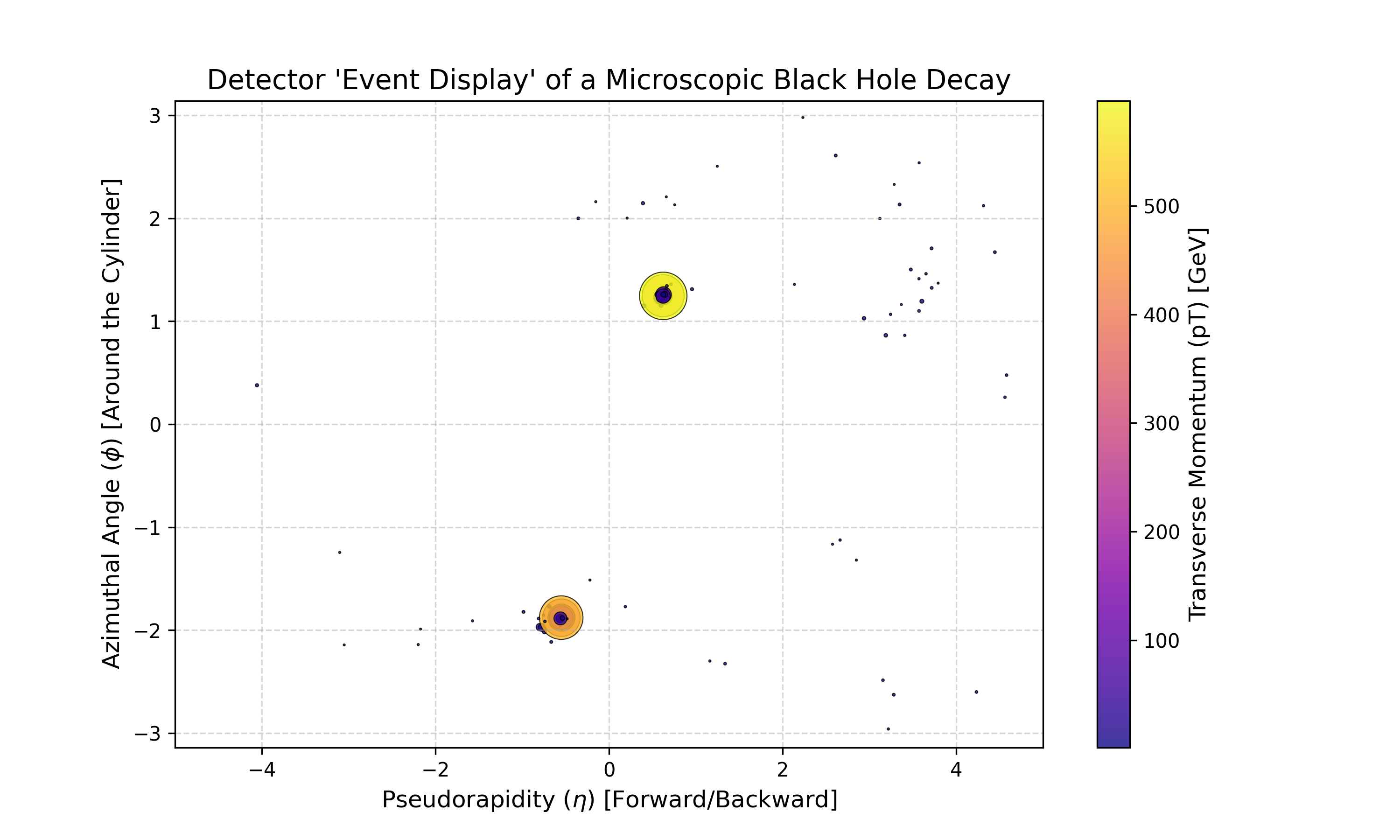
Microscopic Black Hole Decay and Parton Hadronisation
Linked two distinct physics engines — QBH for microscopic black hole production and Pythia8 for parton showering — to model the decay of a microscopic black hole, simulating how the Strong Nuclear Force causes its partons to hadronise into massive particle jets visible in a detector event display.
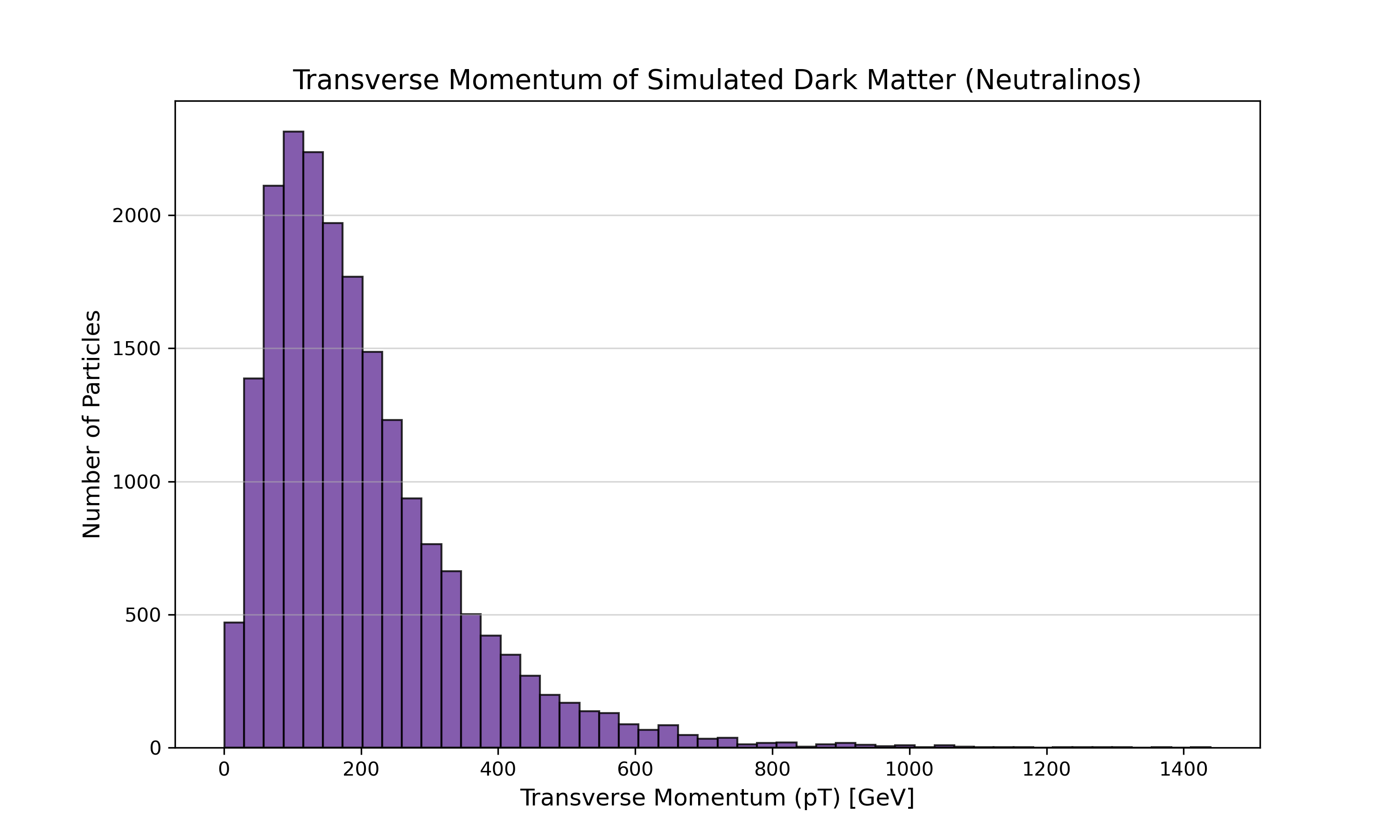
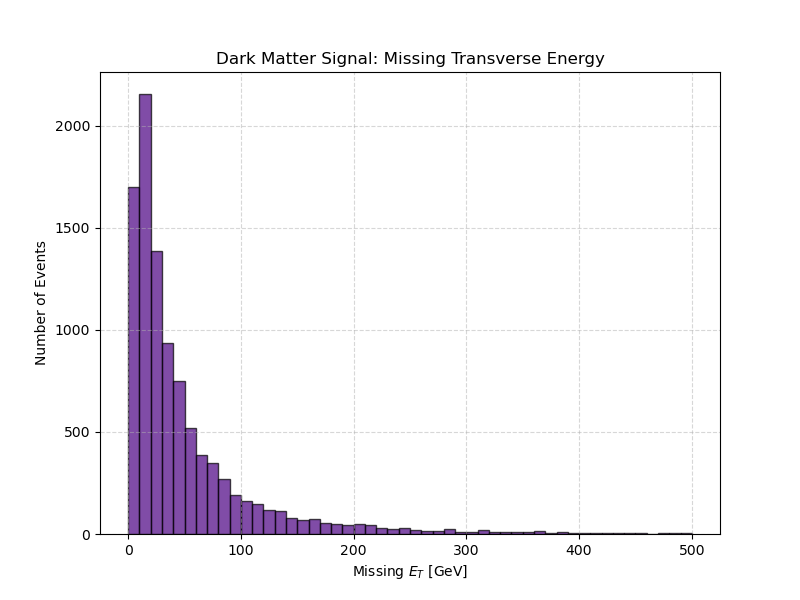
Detector-Level Simulation of Neutralino Dark Matter Signatures
Modelled neutralino dark matter production using a two-step pipeline: generating raw parton-level collision kinematics with MadGraph, then applying Delphes to simulate realistic detector limitations and calculate the observable Missing Transverse Energy (MET) — the canonical signature of weakly-interacting dark matter at colliders.
Antimatter - A Look Into the Future of Energy
What Can a Language Model Do for a Movement Ecologist? Reading Data and Generating Hypotheses
Supervised by Prof. Potts and Prof. Xing. Four language models were tested across two studies on the Ya Ha Tinda elk herd: one asking what structure a model can recover from 234 elk-years of GPS telemetry, the other asking which of an ecologist's existing datasets bear on a question when no data values are supplied at all. Selection holds up well and resists dilution by decoy datasets; judgement does not. The report's clearest result runs against the totals, with the most internally consistent response in the blind tier also being the most incorrect.
A Topological Assessment of the RK4 Method for Chaotic Driven Damped Pendulums
Your Future Quantised; The Practical Superpower of Quantum Mechanics
On the Components of Kinetic Energy During a Barostatted Molecular Dynamics Simulation of Methanol Diffusion in Water
Determining Planck's Constant From Photodiode Responses to LEDs of Differing Wavelengths
Quantum Field Theory for the Gifted Amateur - Tom Lancaster and Stephen J. Blundell
Fictions - Jorge Luis Borges
Friedman–Ramanujan functions in random hyperbolic geometry and application to spectral gaps II
A Short Stay in Hell - Steven L. Peck
For research questions, collaborations, or general inquiries, please use one of the contact details below or alternatively the form below:
olivergtburch@gmail.com
linkedin.com/in/oliver-burch-846b80263
University of Sheffield, UK